
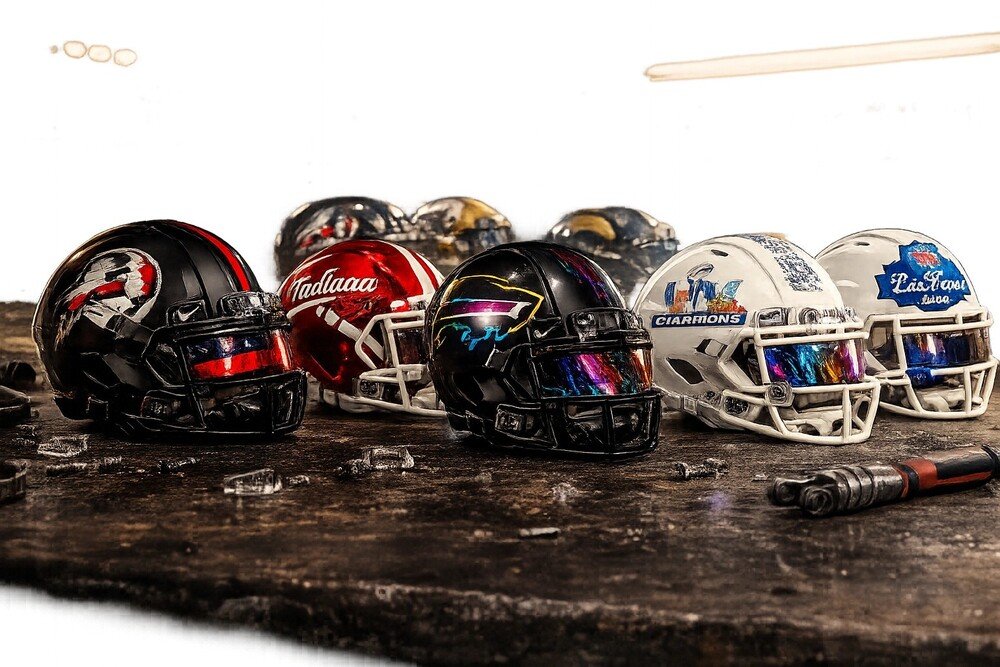
Mini football helmets are one of the easiest ways into sports collecting. They’re affordable, they don’t take much space, and unlike a jersey folded in a drawer or a ticket stub in a shoebox, they actually look like something on a shelf. A dozen of them lined up on a bookcase reads as a collection in a way that most memorabilia never quite manages.
If you’ve been thinking about starting, the hardest part is knowing where to begin. This guide walks through the whole thing — sizes, what to buy first, how to display it, and how to build something that feels like yours rather than a random pile of helmets.
This trips up almost every new collector, so it’s worth getting straight first.
Mini helmets are roughly quarter-scale. They’re the standard collecting size, they fit on a desk or shelf without dominating it, and they’re what most display cases and stands are built for. If you’re starting a collection, this is your default.
Midi helmets sit on a larger shell — closer to half-scale. They have noticeably more presence, and because there’s more surface area, there’s room for finer detail work on the paint and decals. Collectors often use midi helmets as centerpieces: one or two anchoring a shelf of minis.
Full-size helmets are display replicas at actual playing scale. They’re the most expensive, and one takes up the space of five or six minis.
The practical advice: start with minis. Build out a group of them, figure out what you actually enjoy collecting, and add a midi later once you know what deserves the spotlight. Working the other way around — buying one big expensive piece first — tends to leave people stuck.
One thing to know going in: mini and midi helmets don’t share parts. A midi shell needs a midi-sized visor, not a mini one. If you’re mixing sizes, keep that in mind when you order accessories.
A collection without a theme is just a shelf of helmets. A theme is what turns it into something worth showing people, and it’s what makes buying decisions easy instead of overwhelming.
Some approaches that work well for beginners:
One team, deep. Every helmet your team has worn — primary, alternates, throwbacks, blackouts, chrome. This is the most popular starting point and the easiest to explain to visitors.
Your division or conference. All four teams in your division, or every school in your conference. Naturally bounded, so you know when it’s complete.
Personal history. The team you grew up with, your high school, your college, the team your dad watched. This ages better than almost anything else, because the collection means something specific to you.
Tribute and specialty designs. Salute to Service builds, awareness designs, Back the Blue, blackout finishes. These tend to be the pieces people ask about.
Rivalry pairs. Two helmets per matchup, displayed facing each other. Visually strong and it gives the shelf a story.
You don’t have to lock this in forever. But picking a direction now means your first five purchases build toward something instead of scattering.
Three is a good opening number. It’s enough to look intentional on a shelf, not so much that you’ve committed real money before knowing your own taste.
A reliable first three:
That third one matters more than people expect. It’s usually the piece that determines whether the collection stays generic or develops a personality.
When you’re evaluating a helmet, look at the decal work first. Sloppy or misaligned decals are the fastest way to tell a rushed build from a careful one, and it’s the detail you’ll notice every single day once it’s on your shelf. Hand-finished helmets — like the ones we build to order — get inspected before shipping specifically because of this.
Most new collectors buy helmets for a year and then think about display. Do it the other way around and you’ll be much happier.
Acrylic display cases are the standard. They keep dust off, which matters more than you’d think — dust settles into decal edges and face mask gaps, and cleaning a helmet without scuffing the finish is tedious. Standard cases are sized for mini helmets, so check dimensions if you’re displaying a midi.
Riser stands angle the helmet slightly upward. Small thing, big difference — it reads as displayed rather than set down.
Floating shelves work well for growing collections. A row of ten minis at eye level looks considerably better than the same ten crowded onto a bookcase.
Keep them out of direct sunlight. UV fades paint and decals over time. A helmet in a sunny window will look noticeably duller in a couple of years than one across the room.
Once you have a few helmets, the appeal of a custom one becomes obvious: it’s the piece nobody else has.
Common custom requests include:
High school helmets deserve a specific mention here, because they’re one of the most meaningful things you can put on a shelf and a lot of people don’t realize they’re an option. Booster clubs order them for fundraisers, coaches give them as senior night gifts, and parents get them made for players finishing their last season. If that’s relevant to you, our custom high school mini football helmet page covers how ordering works, including bulk pricing for team-sized orders.
For a custom build, bring reference photos. A picture of the actual helmet — or the team’s colors and logo — gets you a far more accurate result than a written description.
The collectors who stay happy long-term tend to follow a few habits:
Buy deliberately, not in bulk. One good helmet every couple of months beats five cheap ones at once. You’ll care about them more and the shelf will look better.
Photograph what you own. Useful for insurance, and it stops you from buying a duplicate two years in.
Upgrade accessories instead of replacing helmets. A new tinted or chrome visor can meaningfully change how a helmet looks for a fraction of the cost of a new build.
Let the theme evolve. Most collections drift over time, and that’s fine. The ones that feel personal usually got that way by accident.
How much does a mini football helmet cost? It varies with design complexity and finish. Standard team designs are the most affordable entry point; chrome, blackout, and fully custom builds cost more because of the additional hand-finishing involved.
What size is a mini football helmet? Roughly quarter-scale — sized for desk and shelf display and designed to fit standard mini helmet display cases and stands.
Do mini helmets come with a visor? Ours ship with a matching visor and visor clips included unless noted otherwise. Upgraded chrome and tinted visors are available separately.
Can I get a helmet for a team that isn’t listed? Yes. Send the team, colors, and reference photos through the Custom Order form and we’ll build it.
Is a midi helmet worth it for a beginner? Usually not as a first purchase. Start with minis, find your theme, then add a midi as a centerpiece once you know which design deserves it.
Browse our mini football helmets to find your first build, or start a custom order if you already know exactly what you want on the shelf.